Monday, September 26, 2016

Mortality From AGW Warming: A Brief Analysis

In a recent FaceBook exchange, the question came up of why I object to the omission from most talk about AGW of the benefits from milder winters. I ended up sketching an approach to the question of whether increased mortality from hotter summers was more or less than decreased mortality from milder winters. It was a longer piece than I usually bother with on FaceBook, which suggested that it would be more appropriate here, so here, with some editing, it is.

I begin with a Lancet article that found that, globally, "cold-related deaths outnumbered heat-related deaths by a factor of nearly 20, overall." To figure out how summed deaths from heat and cold were changed by AGW so far, or estimate how they will be changed in the future, I need two more pieces of information.

1. As temperature rises, what is the relative rise in temperature of winters relative to the rise in temperature of summers. I don't have data on that and it surely varies from place to place, but the physics of greenhouse gas warming implies that it will tend to be larger in cold times than in hot, so I would expect that, on average, winters will get milder by more than summers get hotter. I picked up that point from something Freeman Dyson mentioned in The Scientist as Rebel, and so far as I can tell it is correct.

2. What is the marginal effect on mortality of changes in both highs and lows? What is the percentage increase in mortality due to heat if highs go up by one degree? What is the percentage decrease in mortality due to cold if lows go up by one degree? How do they compare?

So far as I know, data on that do not exist. So I start with the simplest assumption—that the marginal effects are the same. If so, raising both the high and the low by one degree will decrease mortality due to cold by almost twenty times as much as it increases mortality due to heat, as per the Lancet numbers. Since, as per my point 1 above, AGW will on average increase lows by more than it increases highs, a given increase in global temperature due to AGW should decrease mortality due to cold by more than twenty times the amount it increases mortality due to heat.

If the question is whether the net effect is an increase or decrease in total mortality, the argument implies that for the net to be an increase in mortality the marginal effect of higher highs has to be more than twenty times as great as of higher lows. I suppose that's possible but I can not see any reason to expect it. Perhaps someone reading this can point me at data on the marginal effect that would let me replace my guess with something better.

In my experience, news stories on global warming routinely cite figures on increased deaths from hotter summers, current or projected, but give no such figures for decreased deaths from milder winters.

P.S. The Physics

CO2 is a greenhouse gas. So is water vapor. The more of one greenhouse gas in the atmosphere, the less the effect of adding another–the combined effect, after all, cannot be to block more than a hundred percent of the long wave radiation coming up from the Earth. The warmer it is, ceteris paribus, the more water vapor is in the air. Hence the greenhouse effect tends to be less in warm times and places than in cold.

Saturday, September 17, 2016

A Little More on Climate and the Food Supply

A recent post discussed the effect of climate change on the food supply. I now have a little more information.

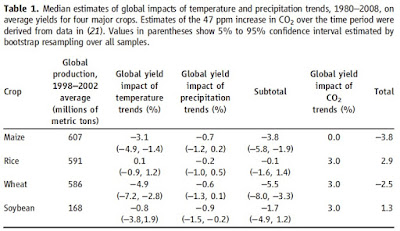
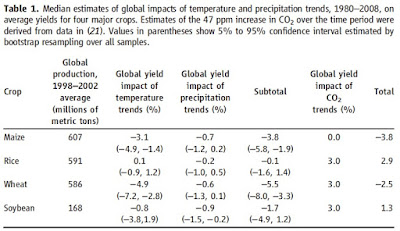
I start with the table from Lobell et. al. 2011 which I showed in my previous post:


The issue was the effect on food supply, so it matters how much of each crop is used for food.
Of the 440 million metric tons (MMT) of polished rice produced in the world in 2010 ( Table 1), 85% went into direct human food supply ( 5 ) . By contrast, 70% of wheat and only 15% of maize production was directly consumed by humans. (Major Cereal Grains Production and Use Around the World)
 Googling around, it looks as though about 6% of soybean production is used directly as human food, 75% as animal feed, some of the rest as soy oil consumed by humans.  I can't find a figure for the total fraction used to feed humans, so am guessing 10%. We then have:

Production and yield are from Table 1 above. The bottom right cell shows a net increase in the amount of the four crops used as human food of about a million metric tons. For a more precise calculation I should have converted tons of each crop into calories. I am assuming that the ratio is not very different for the different crops, but readers are welcome to check that.

In the course of the same conversation, one of the participants insisted that all studies of the future effect of climate change on the food supply showed it to be negative. I don't generally like getting into the game of dueling citations, for reasons I will probably discuss in another post. But I was referred to the latest IPCC report so looked at it, and found a table, Figure 7.5 in Chapter 7, that showed the distribution of predictions of the effect of climate change on mean crop yield over the 21st century. For both temperate and tropical regions, the median prediction was for a negative effect but more than 25% of the studies predicted a positive effect. Looking at the estimates that included the effect of adaptation, farmers changing what they did in response to changing circumstances, the median prediction was for a reduction in yield of less than half a percent per decade.


I think that supports my view of the effect of climate change both on the food supply and more generally–that there are both positive and negative effects, both are quite uncertain, and the sum might turn out to be negative or positive, might make us worse off or better off.

Saturday, September 10, 2016

Future Climate and the Food Supply

I recently had an experience both rare and pleasant, a civil and informative argument about climate on FaceBook. It was started by
One of the commenters, although not prepared to defend the hysterical tone of the posted piece, was willing to argue that climate change was making the global food situation worse and threatened to make it much worse in the future. In defense of that claim, he cited "one recent study showing four major global crops declining (relative to no climate change)." The article, "Climate Trends and Global Crop Production Since 1980"  (Lobell et. al. 2011), was an attempt to separate out the effects on four major crops of different environmental changes–temperature, precipitation, and CO2 concentration–occurring from 1980 to 2008.

Reading it, I noticed that what the authors defined as the effect of climate change included temperature and precipitation but not CO2; its (positive) effect was listed separately. Including it changed the conclusion from four crops down to two down, two up. The commenter who offered the article as evidence had apparently missed that fact.

I also noticed that while they found a significant warming trend over the period, the trend in precipitation was statistically insignificant – consistent with random change. Redoing the calculation using only the two effects we knew were associated with AGW, warming and increased CO2 concentration, made the percentage increase in rice equal to the decrease in maize, the increase in soybeans larger than the decrease in wheat. The figures are shown in Table 1 from the article.

The table showed no effect of increased CO2 on the yield of Maize. Maize, as the gentleman I was arguing with pointed out, is a C4 crop, the other crops C3, the difference being in the details of the mechanism for photosynthesis. The effect of CO2 fertilization on C4 crops is substantially less than on C3 crops but not zero. Looking at another article that had been linked in the discussion, this one from the EPA, I found:
The yields for some crops, like wheat and soybeans, could increase by 30% or more under a doubling of CO2 concentrations. The yields for other crops, such as corn, exhibit a much smaller response (less than 10% increase).
That suggests that the effect is less than a third as large as the effect on the C3 crops but still substantial. Including it on Table 1 makes the negative net effect on maize smaller than the positive effect on rice.

Looking at the EPA article I noticed that the increase in  yield due to CO2 fertilization was presented as a fact, various things that might decrease yields as possibilities.
"if temperature exceeds a crop's optimal level or if sufficient water and nutrients are not available, yield increases may be reduced or reversed." 
"Extreme events, especially floods and droughts, can harm crops and reduce yields."
 No evidence was offered that any of those things would happen or how large the effects would be if they did. It looked as though the authors wanted to give the impression that climate change would reduce agricultural yields but prudently stopped short of saying so.

I also noticed:
"Overall, climate change could make it more difficult to grow crops, raise animals, and catch fish in the same ways and same places as we have done in the past."
As conditions change, people change what they do in response. If temperatures rise, farmers will shift to crop varieties suited to a warmer environment. If rainfall increases or decreases, they will adjust crop varieties, irrigation, other details accordingly. What would happen if farmers ignored environmental changes in deciding how to farm tells us very little about what will happen in the real world. Whether or not we have global warming, it is quite unlikely that, a century from now, people will grow crops, raise animals, and catch fish in the same ways and the same places as they do now.

The same issue is relevant to the other article. The authors estimated the effect of increased temperature on yield by looking at how yields had varied with temperature, year by year, in the past. Those estimates were  used to calculate the effect of the overall increase in temperature over the period and suggest possible effects of future increases.

To see the problem with that approach, consider a farmer at planting time. He does not know how hot the year will be, how much rainfall there will be. Decisions such as when to plant and what varieties to plant can only be based on the expected value of those variables.

A farmer in 2100 knows what changes in climate have occurred over the previous century so  can take account of those changes in how he farms. It follows that models based on observations of year to year variation will show a more negative effect of climate change than can be expected from gradual change over a long period of time. The authors of the article noted that problem along with other limitations to their analysis.

Most of the time, all I learn from arguing climate with people on FaceBook is how unreasonable most people engaged in the argument, on both sides, are. This was a pleasant change. 


I will have to wait to see whether my opponent has become less confident that climate change threatens the global food supply now that he knows that the article that he thought supported that claim is, if anything, mild evidence against it.

Saturday, August 20, 2016

Two Maps I Would Like to See

Suppose you are planning to move–across town or across the country. One consideration in deciding exactly where to move to is the price of housing. With a little effort, you can probably find average house prices in different cities you are thinking of moving to, but that isn't quite the information you want. Low house prices might mean inexpensive houses, but they might also mean small houses in poor condition. What you want is an apples to apples comparison, relative prices for the sort of house you would want to buy.

The data to produce that information almost certainly exist online, since there are extensive databases of webbed real estate listings. Run some regressions on that data and you can use the results to estimate how much the same house costs in different places. The results will also tell you how the price of a house depends on its area, lot size, age, etc. Do it right and the potential buyer can input a description of the house he wants and get estimates of how much it would cost in any of the places he is considering moving to. He can input different house descriptions, compare prices, and use the information to help him decide just how much house he wants to buy and where. The same approach could be used for rental prices. And it could be done not city by city–prices within a single city can vary a lot–but neighborhood by neighborhood. 

What I am imagining is a webbed map. Put in the relevant information about the house or apartment you want, click anywhere on the map, and get a price.

Housing prices are not the only thing you want to know. Another consideration is the crime rate–relevant not only in deciding where to live but where and when to take a walk. The map for that information lets you set a category of crime (burglary, mugging, assault), a time of day, and see a map of the relevant area with crime rates shown by color, running from bright red for the highest to dark blue for the lowest.

I don't know how much of this exists already, but perhaps some of my readers do.

Monday, August 15, 2016

Most People are Nice: A True Story

We are currently visiting with my wife’s mother in Cleveland. Yesterday my daughter went for a walk and got mugged near Case Western Reserve University. She was not hurt but lost her purse and contents, iPhone and iPad.
  
She reported the incident to the police, came home and used Apple’s online service to locate the iPhone and iPad. Getting help from the police was complicated by the fact that the location was near the intersection of Cleveland, East Cleveland, and Cleveland Heights, each apparently with its own police department, but eventually two East Cleveland police met us a block from where the missing items showed on the online map. They went to look, reported back that that side of the street was an empty field, and (reasonably enough) that their searching the whole field was impractical. We asked about our doing some searching, were advised that it was not a safe area for white people (black, rundown neighborhood—one police officer was white, one black, the mugger had been black).

Despite their advice, we did some unsuccessful searching, hoping to find the iPhone by calling it, the iPad by making it beep. A woman in a house across the street was curious about what we were doing, made friendly comments.  An elderly black man with a cane came by, sympathized with our problem. We spoke with a group of elderly blacks on a porch at the other end of the block, also sympathetic. One of the women said she had found a coin purse about where we had been searching, was in the habit of picking things up so had done so. She fetched it. It was the coin purse (empty) from my daughter’s purse, she gave it back to my daughter, told us where she had found it, was clearly very happy that her habit of picking things up had produced a benefit. We searched some more without success.

After we returned to my mother in law’s apartment it occurred to me that we could have located the items more precisely by combining the information from the Apple page with other geographical information. Eventually I used the satellite view on the Google Maps app on my cell phone to determine that the items were probably in one of the dumpsters behind an apartment building at the end of the block. So the next day (today) we returned, posted some reward posters around the dumpsters. My daughter called the phone. I eventually heard it ringing from one of the dumpsters, climbed in, found the purse with the iPhone and iPad. The only thing missing that mattered, other than money, was my daughter’s passport. I removed the posters. The man we had spoken with the previous day passed again, I told him we had found it, he was obviously happy for us.

One lesson was the usefulness of modern technology–if we had not had the ability to track the electronic devices we would never have found them and the purse. The other was support for a conclusion I reached decades ago, after leaving something valuable, possibly my wallet or passport, at a merchant’s stall in Teheran and having it returned to me. You cannot count on everyone being nice, as illustrated by the mugger. But if you select people at random to interact with, the odds are that they will treat you as a fellow human being not an enemy or a victim.

Even in places that the cops warn you are unsafe for people of your race.

Thursday, July 21, 2016

A Story Idea

Someone comes up with a drug, or a technology, that gives the user perfect recall, the ability to rerun, in full detail, any part of his life. How would it get used?

One possibility is for self-education. Observing selected past experiences with a fifty year old mind and seventeen year old eyes might teach me a good deal about mistakes I had made, some of which I might still be making.  It might provide information about what it was like to be seventeen useful in dealing with current teenagers, including my own children. In life as it now is, we get to see each episode only once. As any video game player could tell you, being able to play the same events over and over makes it possible to greatly improve your skill. In my hypothetical, unlike a video game, you don't get to  try different tactics and see what happens. But you do get to see repeated replays of what you did the first time and the results.

Another possibility is entertainment. You can rerun, over and over again, your happiest, most exciting moments. Replace internet porn with memories of your first, or best, sex. Watch a reality show that was real, with yourself as star.

There is, however, a potential down side. After things go wrong, a marital breakup, a business failure, an election loss, it is tempting to go over it again and again, agonizing over what you did wrong and what you should have done. Now you can do it in living color. Forever.

The version of this scenario I have just described is probably impossible, since there is no reason to believe that a full record of my past is actually stored anywhere in my brain. But a different version, enabled by a different technology, might well come into existence in the not too distant future.

Consider a world with greatly improved surveillance, a much advanced version of video cameras on poles combined with face recognition software and database technology. In that world, David Brin's Transparent Society, everything that happens in a public place is recorded and findable. And once we have video cameras with the size and aerodynamic characteristics of mosquitoes, practically every place is public.

If the system is open access we are back with perfect recall. I am no longer watching my past life through the eyes of my past self, but I still get to watch it. 

I was born too early. But it might be reality for my future grandchildren.

Donald Trump and The Boy Who Cried Wolf

In 1964, Fact magazine published an article whose headline was "1,189 Psychiatrists Say Goldwater Is Psychologically Unfit To Be President." It included a variety of detailed and unflattering diagnoses of the Republican candidate for president by psychiatrists none of whom had actually examined him or, so far as one could tell, met him.

In 2010, Christine O'Donnell, a Republican candidate for the Senate, was widely mocked as the "masturbation hating candidate." So far as I could discover, the basis for that was a comment she had made in an MTV program on masturbation some fourteen years earlier:
"The Bible says that lust in your heart is committing adultery. So you can't masturbate without lust."
Both, I think, correct statements. 

That same year, another Republican senate candidate was reported as saying that he opposed the principle of separation of church and state. What he actually said was "The idea that church and state should be separated is fine with me. The idea that there should be no interrelationship between the two is not fine with me."

Those are particular incidents that struck me when they occurred–the two links above are to blog posts I made at the time. But the pattern is a general one. Center left writers and media routinely accuse candidates on the right of being ignorant, stupid, racist, and/or crazy. Most of the time it isn't true.

Donald Trump is, in my view, less  qualified to be president than any major party candidate in my lifetime. But after being told more or less the same thing about every candidate seen as right of center for the last fifty years, why should voters, especially voters right of center, believe it?
-----
P.S. (the day after the election).

A commenter on Facebook provides a link to Bill Maher  admitting what I wrote above--that they cried wolf with previous Republican candidates who really were not all the terrible things they claimed. But this one, he says, is different.

He also makes a testable prediction–that Trump will seize power and remain in office for the rest of his life. Eight years from now I want to see him explain that one assuming, as I do, that it will prove false.

Saturday, July 09, 2016

Observations on London

I recently spent a few days in London and was struck by several features of current London culture:

1. Several times, younger passengers on the Tube (subway) offered me their seats. I have grey hair but do not appear (and am not) particularly feeble. I would be mildly surprised to have the same thing happen in the U.S.

2. Most hotels I have stayed in recently, in the U.S. and abroad, have a safe in the room with a combination that the guest sets. The hotel I stayed at in the U.K. didn't. That might mean that U.K. guests are less worried about pilfering by hotel employees than hotel guests elsewhere. Of course, my sample size is very small.

3. Walking through Notting Hill (no Napoleons visible) I observed the scene shown below, jam offered for sale with a request to put the payment through the house's mail slot.  I cannot remember having ever seen a similar scene here, although I don't suppose it's impossible.

Scotland and the EU

One result of the British vote to leave the EU has been a revival of calls for Scotland to leave the U.K. Doing so is considerably more attractive if combined with EU membership. That raises the question of whether, if Brexit were followed by Scottish secession, the EU would be willing to let the Scots in.

One argument in favor, from the standpoint of the EU, is that encouraging Scottish secession is a way of punishing the U.K. for leaving and so deterring other countries from doing so. One argument against is that allowing a breakaway region to join sets a precedent that some current EU members, most obviously Spain, might be unhappy with. The Scots could, of course, argue that the precedent would only be relevant to the case of breakaway regions from non-member states. The Spanish might or might not be convinced.

Brexit and Free Trade

Much of the discussion of the recent British vote to leave the European Union takes it for granted that the result will be less free trade for the U.K. While that is possible, so is the opposite result. Britain can still negotiate a free trade agreement with the EU, as several non EU countries have done, assuming both sides want it. And leaving the EU leaves Britain free to negotiate free trade agreements with other countries, most obviously the Commonwealth.

The critical issues are the positions of the U.K. government and its potential trading partners, including the EU. Many who voted for Brexit were motivated by a desire to reduce trade and/or immigration, but not all. The winning coalition seems to have included both protectionists and free traders. The free traders who voted for Brexit plus the free traders who voted against it might well add up to a majority.

For those who supported free trade, the objection to the EU was the rest of the package, in particular extensive regulation. Many people take it for granted that if you have free trade such regulation is needed to prevent countries from cheating, regulating the national market in ways that favor their producers. That argument assumes that national governments want to cheat on free trade. It treats a free trade agreement as a deal where each country gives up something it values, its own trade restrictions, in exchange for the other country doing the same. 

Much talk about trade views it that way. Politically speaking that view is correct, since trade restrictions are a way in which politicians can benefit well organized producer groups in exchange for their political support. Economically speaking, however, that view is false. The gain from protecting U.K. manufacturers from foreign competition comes at the cost of their customers and U.K. export industries. 

Unilateral free trade, the policy of England in the 19th century and Hong Kong in the 20th, produces a net benefit for the inhabitants of the country that adopts it, quite aside from any benefits to their trading partners. From the standpoint of the welfare of the citizens rather than their rulers, the usual trade negotiation consists of each side offering to stop shooting itself in the foot in exchange for the other side doing the same. If governments engaged in trade negotiations were trying to maximize the welfare of their inhabitants, there would be no need for either tariffs or agreements on regulation, since there would be no incentive for the governments to use regulation to cheat on trade agreements.

If supporters of free trade in the U.K. and potential trading partners are sufficiently numerous and sufficiently well informed, Brexit should lead to an increase in free trade. If they are numerous but poorly informed, believe that the benefit comes from a trading partner abandoning its restrictions, it still might lead to an increase. We will have to wait and see.

Monday, July 04, 2016

America's Annual Celebration of Lawlessness

Where we live, private fireworks are illegal. Walking around the neighborhood for an hour or so after dark, I must have seen several hundred rockets go up as well as a lot of ground level displays. Lots of people out watching.

It's enough to warm an anarchist's heart.

Wednesday, June 08, 2016

The Origin of the Law of Torture: A Cautionary Tale

[This is a passage I just wrote for a chapter of my current book project, Legal Systems Very Different from Ours. I thought my blog readers might find it of interest.]

People in the past worried about convicting the innocent too. In the early Middle Ages, they had a solution–let God judge. A defendant could be subjected to an ordeal, such as plunging his hand into boiling water, carrying a red hot iron, being dumped bound into water. Various passages in the Bible were interpreted to imply that God would reveal guilt (hand injured or body sank) or innocence (not injured, floated). Since God was omniscient, it was an approach that guaranteed a correct verdict.

The use of ordeals was eventually abandoned on theological grounds. A more careful examination of the biblical passages found little support for it, and it could be viewed as an attempt by humans to compel God to serve them, religiously dubious. In 1215, the fourth Lateran council rejected the religious legitimacy of judicial ordeals and banned priests from participating in them. Over the next few decades most European countries abandoned their use.[1]

That left medieval judicial systems with the problem of finding another way of being certain a defendant was guilty. The solution was to impose a very high standard of proof,  evidence “clear as the noonday sun.” Conviction required either two unimpeachable eyewitnesses to the crime or a voluntary confession. Circumstantial evidence, however strong, was insufficient.

In the history of Western culture no legal system has ever made a more valiant effort to perfect its safeguards and thereby to exclude completely the possibility of mistaken conviction. But the Europeans learned in due course the inevitable lesson. They had set the level of safeguard too high. They had constructed a system of proof that could as a practical matter be effective only in cases involving overt crime or repentant criminals. Because society cannot long tolerate a legal system that lacks the capacity to convict unrepentant persons who commit clandestine crimes, something had to be done … .(Langbein 1978)

The solution was the law of torture. Once the court had half-proof, one eyewitness or the equivalent in circumstantial evidence, the defendant could be tortured into confessing. A confession under torture was not voluntary, but that problem could be dealt with. Stop the torture and the next day ask the defendant if he is still willing to confess. Since he is now not being tortured, the confession is voluntary. If he doesn’t confess, torture him again.

John Langbein, my source for this account, offers a parallel story in modern law. Two hundred years ago, jury trials were short:

In the Old Bailey in the 1730s we know that the court routinely processed between twelve and twenty jury trials for felony in a single day. A single jury would be impaneled and would hear evidence in numerous unrelated cases before retiring to formulate verdicts in all. Lawyers were not employed in the conduct of ordinary criminal trials, either for the prosecution or the defense. The trial judge called the witnesses (whom the local justice of the peace had bound over to appear), and the proceeding transpired as a relatively unstructured “altercation” between the witnesses and the accused. In the 1790s, when the Americans were constitutionalizing English jury trial, it was still rapid and efficient. “The trial of Hardy for high treason in 1794 was the first that ever lasted more than one day, and the court seriously considered whether it had any power to adjourn… .”
Over the years since, trials have become longer and much more complicated, at least in part to reduce the risk of convicting the wrong person. Patricia Hearst’s trial for bank robbery lasted forty days. That was unusually long, but the average felony jury trial in Los Angeles in 1968 took 7.2 days, more than a hundred times the length of a felony trial in the Old Bailey in the 1730’s. If every felony conviction in the U.S. took that long, felony trials alone would require the full time efforts of more than the total number of judges in the state and federal systems.[2] Also the full time efforts of close to a million jurors, court attendants, and the like. Not impossible, but very expensive.

The American legal system found a less expensive alternative. Like its medieval predecessor, it substituted confession for trial. The medieval confession was motivated by the threat of torture. The modern version, a plea bargain, is motivated by the threat of a much more severe sentence if the defendant insists on a trial and is convicted. Like the medieval version, it preserves the form–every felony defendant has the right to a jury trial, a lawyer, and all the paraphernalia of the modern law of criminal defense–while abandoning the substance. Conviction after a lengthy and careful jury trial is, arguably, evidence of guilt beyond a reasonable doubt. The willingness to accept a sentence of a year, possibly a year already served while awaiting trial, instead of the risk of ten years if convicted is not.


[1] For details see  Leeson, Peter, “Ordeals.”
[2] In the U.S. in 2006, an estimated 1.2 million persons were convicted of a felony. If each of them had had a jury trial of 7.2 days the total would have been 8.6 million trial days. Assuming that courts function five days a week, 52 weeks a year, felony cases alone would have required the full time effort of 33,000 judges. Add in a few more for the trials of defendants who were acquitted. There are about 30,000 judges in the state judicial systems, and another 1,700 in the federal system.

Thoughts on the Election

It seems almost certain that the two major party candidates will be Hillary Clinton and Donald Trump, not an inspiring vision. Of the possible bad outcomes, which is least bad?

The answer, I think, is for Hillary Clinton to be elected president with a Republican House and Senate.

The reason is not that I expect Trump, if elected, to shut down the New York Times, order all his opponents arrested, turn his fans into a legion of storm troopers, abolish the Constitution and end democracy in America. However bad his intentions, he cannot do those things by himself. Moves in that direction, even considerably less extreme ones, would be opposed by some Republicans and all Democrats, which means a majority of the House, Senate and Supreme Court.

My worry is in a different direction. A Trump election would almost certainly also give the Republicans a majority in both the House and Senate. A Republican congress can probably be trusted to resist moves by a Democratic president to expand the size and power of government, in particular of the executive. It cannot be trusted to resist similar moves by a Republican president--did not when the president was Bush. 

Insofar as one can guess Trump's real political views and insofar as he has any, they seem to be center left, a fact obscured by his efforts to get Republican primary voters to vote for him. If he acts on such views, probably with wrapping designed to make them as palatable as possible to conservatives, he will probably have support from most Republicans in congress and some Democrats.

Or in other words, I think Trump will be in a position to do considerably more damage than Clinton will be. There is much to be said for gridlock, considering the alternative.

As for the election, if I vote it will be for Gary Johnson on the Libertarian ticket.