Saturday, December 10, 2016

It All Depends Whose Ox is Gored

Recent news stories claim that Russia attempted to influence the U.S. election in favor of Donald Trump. How accurate the claim is I don't know. What seems clear is that the reaction of Americans is that doing that is wrong, cheating, meddling in our affairs. That is why, during the election, the story was popular with Trump's opponents. I expect it still is.

During the build-up to the Brexit vote, Barack Obama gave a talk in the U.K. in which he strongly hinted that if Britain pulled out of the E.U., leaving it free to negotiate its own trade agreements with other countries, the U.S. would not be eager to join such an agreement--“The UK is going to be in the back of the queue.” Pretty obviously, it was an attempt to influence the vote on the referendum. 

I am not sure if its actual effect was in the intended direction or the opposite direction. My impression at the time was that, while most Americans saw nothing wrong with Obama's talk, many in Britain resented the attempt to influence their voting. 

Which explains the title of this post.

Saturday, November 19, 2016

One Argument for the Electoral Vote System

An advantage of the present system that I have not seen discussed is that it reduces the problem of vote fraud. Stealing votes is easiest in a state dominated by a single party, the sort of place where the Republican poll watchers probably work for the Democrats or vice versa. With the electoral college system, there is no point to stealing votes in such a state, since the dominant party is going to get all of its electoral votes anyway. With a straight majority vote system, on the other hand, each party has an incentive to steal all the votes it can wherever it can.

Even with the electoral vote system, the problem still exists in any state where one party controls a large area, such as a major city, but the other  has enough support elsewhere to make the overall result uncertain. I still remember, long ago when I lived in Chicago, being told that the reason the downstate votes had not come in yet was that they were waiting to see how many they had to steal to outweigh the efforts of the Chicago machine.

More Inventions I Would Like To See

A Still Better Shower

The conventional controls for a shower or sink consist of one for hot water, one for cold. Getting your preferred mix is a process of trial and error adjustment, repeated every time you take a shower or wash your hands.

An improved version, now fairly common, has one control for the hot/cold ratio, another for the volume. Having once gotten the ratio right you can leave that control at your preferred setting and use the volume control to turn the water on at the beginning of your shower, off at the end.

Provided you are in no hurry. When I turn the water on the shower runs cold because it takes time for water to get from the water heater in the basement to the bathroom on the second floor. To reduce my wait, I shift the shower to all hot. That not only gets hot water to me faster, it also means that while I am waiting I am not wasting cold water down the drain. But now, when the water warms up, I have to find the proper mix. Every time I take a shower. It's an improvement over the older version, since I can to some extent set the ratio control by memory. But it could be better.

The simple solution is to add a control which shifts the shower to all hot temporarily without changing the lever that will set the ratio once that control is turned off.

Since I am in Silicon Valley and greedy, I am still not satisfied. The high tech version  monitors water temperature. As long as my desired temperature is impossible because what is coming out of the hot water pipe is colder than that, it runs straight hot. Once the temperature of the hot water gets high enough it automatically starts adding in cold, keeping the shower temperature at my optimum thereafter. The luxury model has a light, or perhaps a bell, to tell me when it is safe to get into the shower.

Making Conversation Possible

You are in a crowded restaurant, a bar, a meeting room filled with people. There is someone you are trying to converse with. Since the environment is noisy, you raise your voice. So does everyone else. As the room becomes louder, conversation becomes increasingly difficult, perhaps impossible.

There is a simple solution. Everyone wears a bluetooth earpiece/mike. Look at someone, next to you or across the room, click a button on the earpiece. Your earpiece is now linked to hers, so you can converse quietly. Setting the link by looking at someone may require Google Glass, but there is a lower tech version, some easy identifier, perhaps a number on the name tag that everyone at the event wears.

Social norms would have to be worked out. The person you want to speak with may not want to speak with you, so there needs to be some way of accepting or denying the request to link. In a room full of conversations I am quite likely to be wondering around looking for interesting ones, which is hard to do if I cannot hear them. So there should be an option to make the conversation open, meaning that anyone who chooses can listen and join in, or closed.

So far as I can tell, all the technology needed already exists and would be reasonably inexpensive to implement. All it takes it an enterprising entrepreneur.

Before you go into business, however, there is one question you may want to consider. In quite a lot of the environments I am describing, the noise is not merely accidental. Bars, in particular, tend to play music, often loud enough to make conversation even more difficult than it would otherwise be. That suggests that some people, perhaps many people, prefer a noisy environment. The only reason I can think of for such a perverse taste is the increased privacy–at some level of background noise, nobody more than four feet away can hear what you are saying. My technology should provide a better solution to that problem. 

But there may be other reasons I have not thought of.

Sunday, November 13, 2016

Four Possible Trumps

1. The Nightmare. A wild man who offends all our allies and enemies and everyone else and declares war on Kyrgystan to punish it for being too hard to spell.

2. Promise Keeper/Paladin of the Right.  Trade barriers up, immigration down, many illegals expelled. Everything the government was doing that offended his base, from restrictions on burning carbon to pressuring colleges to lower their standard for convicting students accused of sexual assault, cancelled or reversed.

3. Virtuous Traitor. All the bad ideas on immigration and trade either retracted, forgotten, or deliberately proposed in versions Congress won't pass. All the good ideas–school vouchers, reduced regulation, legalizing interstate sales of health insurance, replacing Obamacare with something that works, simplifying the tax code–implemented.

4. Hillary+. Lots of ideas the left likes–increased government spending, increased borrowing, free colleges, student loan forgiveness–implemented with the support of most of the Democratic party and parts of the Republican.

All of these are possible. The first is less likely and the last more likely than most commenters, especially on the left, think. The belief that Trump is crazy is based on his performance during the campaign, repeatedly doing things that would obviously result in his losing. Since they resulted in his winning, one has to revise that judgement and consider that perhaps he is crazy like a fox. 

The belief that he is a right winger is also based on his performance during the campaign. There too, the fact that it worked suggests that his positions may have been tactical, not ideological. We do not know what ideological beliefs, if any, he actually has. Things he has said in the years before are at least equally consistent with viewing him as center left.

That is half of the argument for the final possible Trump. The other half is George Bush. Bush was elected as a conservative. He proceeded to sharply increase spending, the deficit, and government control over education. Spending money is generally popular, lowering taxes is generally popular, and there are usually political points to be made by "doing something" about whatever people at the moment want something done about.

My guess is that the two least likely outcomes of the election are the first and worst and the third and best.

Wednesday, November 09, 2016

Silver Lining?

This was not my least bad among the possible electoral outcomes. But now that it has happened, it is worth looking at whether anything good might come of it. I see three possibilities:

1. Trump might turn out to be better than I expect. Judging by the campaign, he is a skilled demagogue with no particular political principles of his own, which makes him a high variance actor. Looking at his list of what he plans to do in his first hundred days, it is a mix of things I am strongly opposed to, such as restrictions on trade and immigration, and things I am strongly in favor of, such as support for school vouchers and legalizing the sale of health insurance across state lines. Trump might decide, for reasons of politics or ego, to act mostly on the ones I like. One can always hope.

2. One of the problems which I think partly explains Trump's victory is the arrogance and condescension of the coastal elites towards "flyover country." In one online exchange, someone responded to that point by explaining that they were just acting that way because the people they treated that way were all racists and misogynists (by memory, so not verbatim), thus nicely illustrating the problem. Arguing climate issues online, I am struck by how poor the scientific understanding is of most of the people on both sides, including the ones who imagine that they are the upholders of science against the deniers thereof.

With luck, Trump's victory will jolt some of those people into rethinking their self-image as the ruling elite. For a first step in that direction, from just before the election, consider Cass Sunstein's proposed reading list for liberals, books intended to let them see that there exist serious critiques of their views. I will forgive Cass for not including anything of mine since he starts the list with Seeing Like a State, a good and interesting book by someone who makes it clear that he isn't a libertarian–while writing things that libertarians will very much like.

3. If, contrary to my hopes in 1 above, Trump continues with the positions that won him the nomination and the election, that will mean a Republican party less friendly to libertarian views. That plus Trump's victory might make the Democrats willing to think seriously about how to pull libertarian voters into their coalition, something I have been hoping for for a long time.

Tuesday, November 08, 2016

Wishful Thinking on Election Night

I have been saying for some time that the least bad outcome there is any reasonable chance of getting from this unfortunate election is Hilary Clinton in the White House but both houses of congress held by the Republicans. It occurred to me that one possible way of getting there would be if Trump voters, including ones not normally Republican, voted for the whole ticket, while anti-Trump Republicans confirmed their party loyalty by voting for every Republican on the ticket other than Trump.

I am posting this now as results are just beginning to come in so that if it turns out that way, which seems unlikely but not impossible, I can claim to have predicted it--or at least raised the possibility. One early result that might be a tiny bit of evidence is the early vote in Ohio, which shows the Republican senator believed to be at risk being reelected by a sizable margin while Clinton leads Trump, also by a sizable margin, although apparently not enough for the news organizations to have called the race yet.

Friday, November 04, 2016

Ruins in the Southwest, a Query

I am currently working on a book on legal systems very different from ours, one chapter of which deals with the Plains Indians. One of my sources is an account by someone who was captured by Comanche, spent three years as their slave, and eventually escaped. It contains a description of some elaborate ruins that he claims to have observed.
“I saw, with infinite astonishment and surprise, the dilapidated ruins of a large town. In the midst of the falling walls of a great number of buildings, which, in some remote age, beyond doubt, had lined spacious streets, was what appeared to have been a church or cathedral. Its walls of cut stone, two feet thick, and in some places fifteen feet high, included a space measuring two hundred feet in length, and, perhaps, one hundred in width. The inner surface of the walls in many places was adorned with elaborate carved work, evidently the labor of a master hand, and at the eastern end was a massive stone platform which seemed to have been used as a stage or pulpit.” (Nelson Lee, Three Years Among the Comanches, Baker Taylor Company, Albany, N.Y. 1859.)
Lee was captured at a location that he describes as about 350 miles northwest of Eagle Pass, which would put him at about the southeast corner of what is now New Mexico, but traveled a substantial distance with his captors thereafter. 

I am not aware of any ruins in the area that come close to fitting his description. It occurred to me that one of my readers might be. If, as I suspect, the description is fictional, intended to make a better story, that casts some doubts on other elements of his account more relevant to my interest in it.

Tuesday, November 01, 2016

If the Crown Controls Prosecution ...

Quite a long time ago, I published an article on the legal system of 18th century England. On paper, it was our legal system–indeed, where our system came from. But there were no police, no public prosecutors, and criminal prosecution was almost entirely entirely private, usually by the victim or someone acting for him.

The system raised a lot of questions, many of which are discussed in the relevant chapter of the book I am now writing, a draft of which is webbed for comments. One of them is why the English did not have the standard modern system, where catching and convicting criminals is the job of the state. They knew about it. France had such a system, and arguments for it were made in England.

One explanation I have sometimes offered is that, after the chaos of the 17th century–two civil wars, a military dictatorship, and two coups–it occurred to people that if the Crown controlled prosecution, the King's friends could get away with murder. When I give a talk on "Should We Abolish the Criminal Law" (my favorite title), that is one of the arguments I offer, with references to a number of modern cases, starting with the Black Panther shooting in 1969, where government actors committed serious crimes for which they were never prosecuted. My most recent example is James Clapper, Director of National Intelligence, being asked ""Does the NSA collect any type of data at all on millions or hundreds of millions of Americans?" and responding, in sworn testimony, "No, sir."

Recently, reading about the activities of John Wilkes, an 18th century radical libertarian journalist and politician (after whom John Wilkes Booth was named), I discovered some 18th century support for my interpretation. The following is from a draft chapter:
Since any Englishman could prosecute a criminal case, the fact that an offense was approved of by the authorities was no guarantee that it would not be prosecuted. The point was demonstrated when a demonstration in favor of imprisoned radical John Wilkes ended with troops firing into the crowd and killing several people. The Wilkites responded by charging several of the soldiers, the magistrate who had ordered the troops to fire and the other magistrates present with murder.

The king had the power to pardon a convicted felon but doing so in too obviously partisan a way might provoke public outrage. In one notorious case two convicted murderers were pardoned, apparently because their sister’s aristocratic lovers applied political pressure on their behalf (“the mercy of a chaste and pious prince extended cheerfully to a wilful murderer, because that murderer is the brother of a common prostitute”). The Wilkites responded by raising money to fund an appeal of murder, a private criminal case. An appeal was a complex, expensive and difficult proceeding that had gone almost entirely out of use. It had, however, one large advantage:

“If the appellee be found guilty, he shall suffer the same judgement as if he had been convicted by indictment: but with this remarkable difference; that on indictment, which is at the suit of the King, the King may pardon and remit the execution; on an appeal, which is the suit of a private subject, to make an atonement for a private wrong, the King can no more pardon it, than he can remit the damages recovered in an action of battery.” (Blackstone)
The appeal failed, as did the earlier criminal prosecutions, but like them demonstrated the possibility of using privately prosecuted criminal law against malefactors supported by the government
Wilkes is an interesting character. At various points in his life he was an outlaw, a prisoner, a member of parliament and Lord Mayor of London. He is arguably responsible for the Fourth Amendment to the U.S. Constitution. The city of Wilkes-Barre is named after him (and Barre). His biography is worth reading. And he is the source, or at least had attributed to him, some very good quotes:
When told by a constituent that he would rather vote for the devil, Wilkes responded: "Naturally." He then added: "And if your friend decides against standing, can I count on your vote?"
At one point in his extended feud with George III, Wilkes was asked to make up a table of cards. He declined, explaining that he was so ignorant of cards that he could not tell a king from a knave.

In a famous exchange with John Montagu, 4th Earl of Sandwich, where the latter exclaimed, "Sir, I do not know whether you will die on the gallows or of the pox," Wilkes is reported to have replied, "That depends, my lord, on whether I embrace your lordship's principles or your mistress." (But that one may really be by Samuel Foote)

My Recent Talks

I recently gave several talks at Southeast Missouri State University, and videos have now been webbed:

For a class on the principles of microeconomics.
For a reading group on "Free to Choose"

A couple of days earlier I gave a talk in Charlotte for a Students for Liberty event on "What is Economics and Why It Isn't Boring." It is now up.

A few days before that, I gave a talk for the SCU Federalist Society group on "Should We Abolish the Criminal Law," with commentary by a colleague.

I don't usually give quite that many talks in a period of under a week, but since I did I thought some readers of the blog might be interested. Recordings of many other talks I have given are webbed on my site.

P.S. There is now a link to a recording of my Charlotte talk.

I Conjectured. Estonia did it.

One of the new chapters for the third edition of The Machinery of Freedom discusses the question of how a stateless society might defend against a state, which I regard as the hardest problem for such a society.  One of the possibilities I raise is having people voluntarily train and equip themselves for warfare for the fun (and patriotism) of it, as people now engage in paintball, medieval combat in the Society for Creative Anachronism, and various other military hobbies.

A correspondent sends me a real world example of the approach--the Estonian Defense League, civilians trained in the skills of insurgency. They refer to it as "military sport." Competitions almost every week. Membership of 25,400.

Estonia's army of 6000 wouldn't have much chance against a Russian invasion but the Estonians believe, with the examples of Iraq and Afghanistan in mind, that a large number of trained and armed insurgents could make it expensive. 

Estonia has a population of 1.3 million. Scale up to the size of the U.S. and you get a militia of almost six million. Of course, that assumes an anarchist U.S. with a population as committed to its defense as the current population of Estonia.

Monday, September 26, 2016

Mortality From AGW Warming: A Brief Analysis

In a recent FaceBook exchange, the question came up of why I object to the omission from most talk about AGW of the benefits from milder winters. I ended up sketching an approach to the question of whether increased mortality from hotter summers was more or less than decreased mortality from milder winters. It was a longer piece than I usually bother with on FaceBook, which suggested that it would be more appropriate here, so here, with some editing, it is.

I begin with a Lancet article that found that, globally, "cold-related deaths outnumbered heat-related deaths by a factor of nearly 20, overall." To figure out how summed deaths from heat and cold were changed by AGW so far, or estimate how they will be changed in the future, I need two more pieces of information.

1. As temperature rises, what is the relative rise in temperature of winters relative to the rise in temperature of summers. I don't have data on that and it surely varies from place to place, but the physics of greenhouse gas warming implies that it will tend to be larger in cold times than in hot, so I would expect that, on average, winters will get milder by more than summers get hotter. I picked up that point from something Freeman Dyson mentioned in The Scientist as Rebel, and so far as I can tell it is correct.

2. What is the marginal effect on mortality of changes in both highs and lows? What is the percentage increase in mortality due to heat if highs go up by one degree? What is the percentage decrease in mortality due to cold if lows go up by one degree? How do they compare?

So far as I know, data on that do not exist. So I start with the simplest assumption—that the marginal effects are the same. If so, raising both the high and the low by one degree will decrease mortality due to cold by almost twenty times as much as it increases mortality due to heat, as per the Lancet numbers. Since, as per my point 1 above, AGW will on average increase lows by more than it increases highs, a given increase in global temperature due to AGW should decrease mortality due to cold by more than twenty times the amount it increases mortality due to heat.

If the question is whether the net effect is an increase or decrease in total mortality, the argument implies that for the net to be an increase in mortality the marginal effect of higher highs has to be more than twenty times as great as of higher lows. I suppose that's possible but I can not see any reason to expect it. Perhaps someone reading this can point me at data on the marginal effect that would let me replace my guess with something better.

In my experience, news stories on global warming routinely cite figures on increased deaths from hotter summers, current or projected, but give no such figures for decreased deaths from milder winters.

P.S. The Physics

CO2 is a greenhouse gas. So is water vapor. The more of one greenhouse gas in the atmosphere, the less the effect of adding another–the combined effect, after all, cannot be to block more than a hundred percent of the long wave radiation coming up from the Earth. The warmer it is, ceteris paribus, the more water vapor is in the air. Hence the greenhouse effect tends to be less in warm times and places than in cold.

Saturday, September 17, 2016

A Little More on Climate and the Food Supply

A recent post discussed the effect of climate change on the food supply. I now have a little more information.

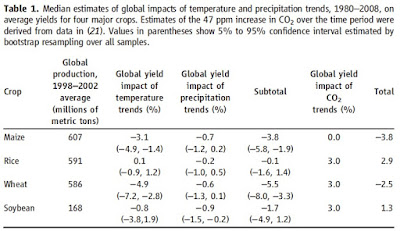
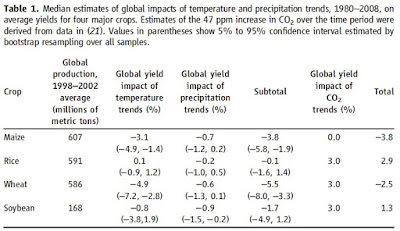
I start with the table from Lobell et. al. 2011 which I showed in my previous post:


The issue was the effect on food supply, so it matters how much of each crop is used for food.
Of the 440 million metric tons (MMT) of polished rice produced in the world in 2010 ( Table 1), 85% went into direct human food supply ( 5 ) . By contrast, 70% of wheat and only 15% of maize production was directly consumed by humans. (Major Cereal Grains Production and Use Around the World)
 Googling around, it looks as though about 6% of soybean production is used directly as human food, 75% as animal feed, some of the rest as soy oil consumed by humans.  I can't find a figure for the total fraction used to feed humans, so am guessing 10%. We then have:

Production and yield are from Table 1 above. The bottom right cell shows a net increase in the amount of the four crops used as human food of about a million metric tons. For a more precise calculation I should have converted tons of each crop into calories. I am assuming that the ratio is not very different for the different crops, but readers are welcome to check that.

In the course of the same conversation, one of the participants insisted that all studies of the future effect of climate change on the food supply showed it to be negative. I don't generally like getting into the game of dueling citations, for reasons I will probably discuss in another post. But I was referred to the latest IPCC report so looked at it, and found a table, Figure 7.5 in Chapter 7, that showed the distribution of predictions of the effect of climate change on mean crop yield over the 21st century. For both temperate and tropical regions, the median prediction was for a negative effect but more than 25% of the studies predicted a positive effect. Looking at the estimates that included the effect of adaptation, farmers changing what they did in response to changing circumstances, the median prediction was for a reduction in yield of less than half a percent per decade.


I think that supports my view of the effect of climate change both on the food supply and more generally–that there are both positive and negative effects, both are quite uncertain, and the sum might turn out to be negative or positive, might make us worse off or better off.

Saturday, September 10, 2016

Future Climate and the Food Supply

I recently had an experience both rare and pleasant, a civil and informative argument about climate on FaceBook. It was started by
One of the commenters, although not prepared to defend the hysterical tone of the posted piece, was willing to argue that climate change was making the global food situation worse and threatened to make it much worse in the future. In defense of that claim, he cited "one recent study showing four major global crops declining (relative to no climate change)." The article, "Climate Trends and Global Crop Production Since 1980"  (Lobell et. al. 2011), was an attempt to separate out the effects on four major crops of different environmental changes–temperature, precipitation, and CO2 concentration–occurring from 1980 to 2008.

Reading it, I noticed that what the authors defined as the effect of climate change included temperature and precipitation but not CO2; its (positive) effect was listed separately. Including it changed the conclusion from four crops down to two down, two up. The commenter who offered the article as evidence had apparently missed that fact.

I also noticed that while they found a significant warming trend over the period, the trend in precipitation was statistically insignificant – consistent with random change. Redoing the calculation using only the two effects we knew were associated with AGW, warming and increased CO2 concentration, made the percentage increase in rice equal to the decrease in maize, the increase in soybeans larger than the decrease in wheat. The figures are shown in Table 1 from the article.

The table showed no effect of increased CO2 on the yield of Maize. Maize, as the gentleman I was arguing with pointed out, is a C4 crop, the other crops C3, the difference being in the details of the mechanism for photosynthesis. The effect of CO2 fertilization on C4 crops is substantially less than on C3 crops but not zero. Looking at another article that had been linked in the discussion, this one from the EPA, I found:
The yields for some crops, like wheat and soybeans, could increase by 30% or more under a doubling of CO2 concentrations. The yields for other crops, such as corn, exhibit a much smaller response (less than 10% increase).
That suggests that the effect is less than a third as large as the effect on the C3 crops but still substantial. Including it on Table 1 makes the negative net effect on maize smaller than the positive effect on rice.

Looking at the EPA article I noticed that the increase in  yield due to CO2 fertilization was presented as a fact, various things that might decrease yields as possibilities.
"if temperature exceeds a crop's optimal level or if sufficient water and nutrients are not available, yield increases may be reduced or reversed." 
"Extreme events, especially floods and droughts, can harm crops and reduce yields."
 No evidence was offered that any of those things would happen or how large the effects would be if they did. It looked as though the authors wanted to give the impression that climate change would reduce agricultural yields but prudently stopped short of saying so.

I also noticed:
"Overall, climate change could make it more difficult to grow crops, raise animals, and catch fish in the same ways and same places as we have done in the past."
As conditions change, people change what they do in response. If temperatures rise, farmers will shift to crop varieties suited to a warmer environment. If rainfall increases or decreases, they will adjust crop varieties, irrigation, other details accordingly. What would happen if farmers ignored environmental changes in deciding how to farm tells us very little about what will happen in the real world. Whether or not we have global warming, it is quite unlikely that, a century from now, people will grow crops, raise animals, and catch fish in the same ways and the same places as they do now.

The same issue is relevant to the other article. The authors estimated the effect of increased temperature on yield by looking at how yields had varied with temperature, year by year, in the past. Those estimates were  used to calculate the effect of the overall increase in temperature over the period and suggest possible effects of future increases.

To see the problem with that approach, consider a farmer at planting time. He does not know how hot the year will be, how much rainfall there will be. Decisions such as when to plant and what varieties to plant can only be based on the expected value of those variables.

A farmer in 2100 knows what changes in climate have occurred over the previous century so  can take account of those changes in how he farms. It follows that models based on observations of year to year variation will show a more negative effect of climate change than can be expected from gradual change over a long period of time. The authors of the article noted that problem along with other limitations to their analysis.

Most of the time, all I learn from arguing climate with people on FaceBook is how unreasonable most people engaged in the argument, on both sides, are. This was a pleasant change. 


I will have to wait to see whether my opponent has become less confident that climate change threatens the global food supply now that he knows that the article that he thought supported that claim is, if anything, mild evidence against it.